HemoSpat News

HemoSpat IconFORident Software is pleased to announce the release of HemoSpat v1.5 for Mac OS X 10.5 [Intel], Mac OS X 10.6 [Intel], Windows XP, Windows Vista, and Windows 7.

The larger changes include the ability to use the left-handed coordinate system, the addition of an experiment mode, the addition of an auto-save feature, and more flexibility when dealing with downward moving stains. We also added many options to the DXF exporter and the 2D Viewer.

There are many other changes and fixes as well. For download links and a more complete list of changes, please see the release notes.

We look forward to hearing any feedback from you!

DeWayne Morris of the Illinois State Police (ISP) presented a talk at a recent SWGSTAIN meeting on combining panoramic photography, data exported from HemoSpat, and a 3D model of the scene. The goal is to provide a real-time virtual 3D environment to be used as demonstrative evidence to expert testimony.

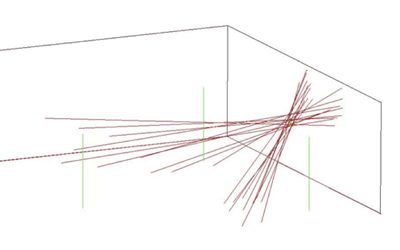
The details of the process are too long to post, but essentially you start with 3D data exported from HemoSpat using the DXF exporter:

ISP - 3D HemoSpat data

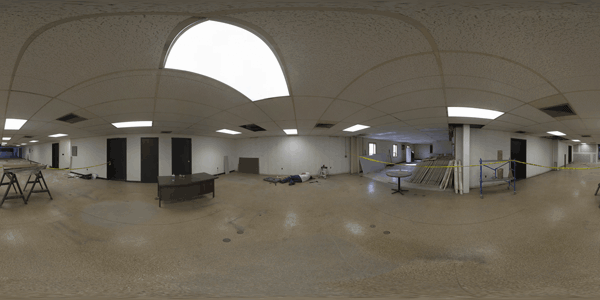
…and a spherical panoramic photo of the crime scene…

ISP - Panoramic crime scene photo

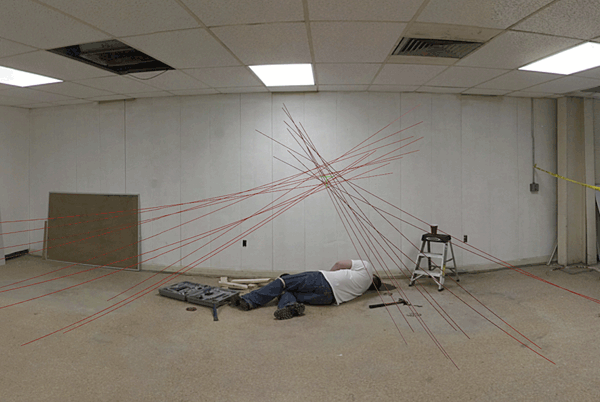
…and then combine them using the 3ds Max modelling software:

ISP - Panoramic crime scene photo with HemoSpat data

Then you can render it as a Quicktime VR movie which lets you navigate the scene as a virtual 3D environment.

I love seeing people do new and interesting things like this! Thanks to DeWayne and the ISP for permission to use the images.

Journal of Forensic Identification

The March/April 2011 issue of the Journal of Forensic Identification contains an article titled One-Sided Impact Spatter and Area-of-Origin Calculations. This is the result of a combined effort of FORident Software, L’Institut de Recherche Criminelle de la Gendarmerie Nationale in Paris, France, and the Forensic Identification Section of the Ottawa Police Service in Ottawa, Canada.

The purpose of this study was to examine impact patterns where stains from only one side of the pattern were available to determine what information we could generate from them.

The abstract of the paper is available on our new Bloodstain Research page. [We will also make the paper available there if we receive a PDF.]

If you have any comments or suggestions, please feel free contact us.

ACSR Conference 2011 Jacksonville, FL, USA

I attended the 2011 Association for Crime Scene Reconstruction [ACSR] conference in Jacksonville, FL, USA last week. Thanks to Tom Brady, Michael Maloney, and the NCIS team for organizing the conference and especially for giving me the opportunity to present a workshop on HemoSpat and a talk on my cast-off pattern research. Special thanks to Walter for helping me set up and tear down the workshop.

This was my first ACSR conference and I’d like to thank the ACSR members and other attendees for making me feel so welcome. The talk highlights for me at this conference were Digital Mapping of Differential Oxidation Arising From Fingerprint Sweat Deposits presented by Dr. John Bond [Scientific Support Department, Northamptonshire Police, England], Hijacked Naval Vessel Scene Investigation and the Impact of Forensic Reconstruction by E. Toomer, and Wound Mapping: A Reconstruction Technique by Michael Maloney [Bevel, Gardner & Associates].

I also had the opportunity to take a full day Basic Digital Forensic Photography workshop with “Nikon Ron”. I found it really useful to get a breakdown of the basics and to get some hands-on experience through the exercises we completed. Thanks again to Walter for lending me his camera!

If you attended the conference and saw my presentation on Visualization of Linear Cast-off Patterns I’d really appreciate any feedback you may have on either the subject or my presentation delivery.

Next year’s ACSR conference is in Monterey, CA, USA. Should be fun and I’m sure the hospitality suite will be well stocked for this one!

Andy Maloney

Lead Developer, HemoSpat

Bloodstain Search and EnchanceMartin Eversdijk [Loci Forensic Products] and Paul Kish [Forensic Consultant & Associates] are conducting a Visualization of Latent Bloodstains course at Elmira College in Elmira, NY, USA. There are two sessions: 6-10 June, 2011 and 13-17 June, 2011. Each session is limited to 16 participants.

This course will provide the participants with first-hand knowledge of how and when to employ searching and enhancement techniques to locate and visualize latent bloodstains. Students will acquire first-hand knowledge of the benefits as well as the limitations of commonly used chemical searching and enhancement techniques.

Upon completion of this course, the participants will have acquired a basic understanding of how and when to use blood searching and enhancing chemicals to assist in their investigation where latent blood is suspected.

This course is recommended for investigators, crime scene technicians, and forensic scientists who routine search for blood at crime scenes as well as on articles of physical evidence.

Some of the topics include:

  • Searching vs. Enhancing Techniques
  • Blood Searching Techniques using Luminol, Lumiscene, and Fluorescein
  • Blood Enhancement Techniques including Amido Black, Acid Fuchsin (Hungarian Red), Aqueous Leucocrystal Violet (ALCV), Titanium Dioxide, and others
  • Photographic Documentation
  • Introduction to IR Photography
  • Health and Safety Issues

For more information, you may download the brochure at the Loci Forensic Products Lumiscene page.